

Why I Own a Bee Suit
rest, restoration, and the things that bring us home

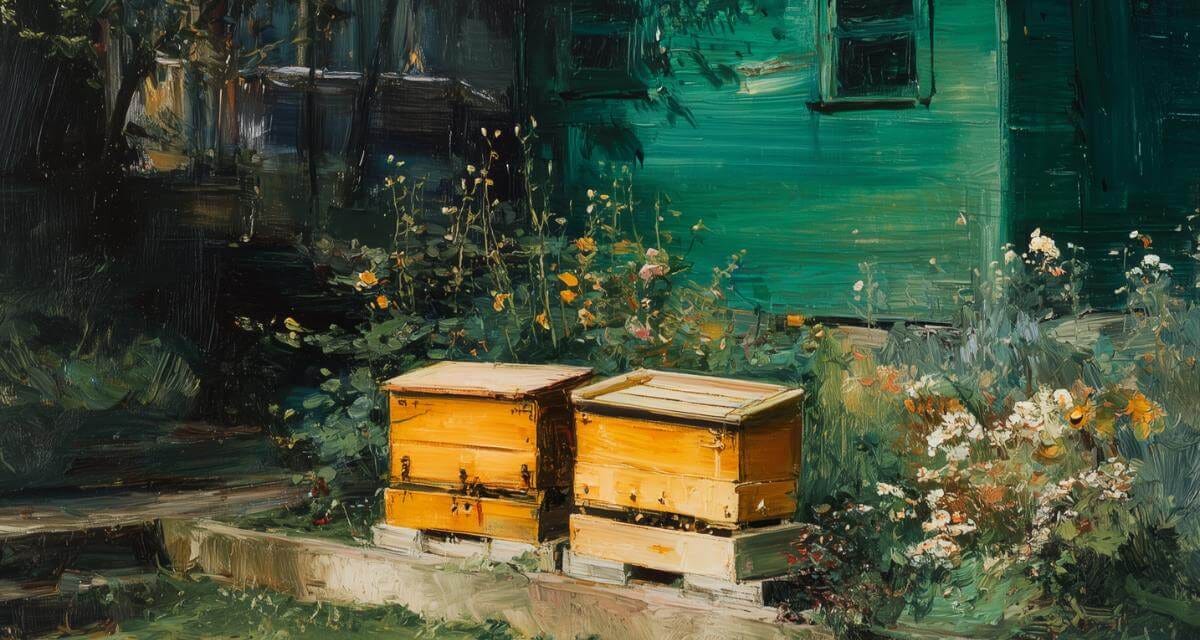
I have bees. I got them last year, and now, once a month, I slip on a white bee suit, light a smoker and check on two hives in my backyard with my beekeeping “mentor.” He and I pull off the lids, check for mites and ants, take out some frames to see how the bees are doing and what they’re building — and whether they need any help.
To get them through Northern California’s winter season, they did need a bit of help in the form of sugar syrup. Josman and I filled a frame feeder with syrup from a tank in his truck. We then removed two frames and installed the feeder in their place. And I am pleased to say that both hives have now made it through the worst of the cold and rain, though one hive is clearly stronger than the other.
Okay, I imagine a question bubble might have just appeared over your head, containing these words: Umm, bees?
I’ll grant you that it doesn’t make much sense, not in today’s culture. Given my vocation, investing time in bee hives isn’t productive, not in the way our world thinks about productivity. It contributes nothing to my work. It does little for my family. (The bee suit gives them something new to tease me about, of course, and they do that.)
So, what gives? Why did I start keeping bees in our backyard?
I think doing things like this actually is productive. I do. In fact, I think it’s vital.
God designs us for work. But that’s not all. He also designs us for peace, rest, and restoration. He designs us for activities and experiences outside work, for pleasure and joy, things that are rich and restorative.
These kinds of things are crucial for physical and mental strength and vitality. Without them, I think we stand no chance of becoming the people we’re meant to be — robust people leading robust lives holding robust faith.
Crucial as I believe they are, our workaholic culture, of course, cautions us against them. It tells us that these kinds of things are childish and irresponsible. It teaches us that during our most “productive years,” we should shortchange everything else in favor of whatever directly contributes to what our culture holds most important: money and our ascent to achievement and status.
But the consequences of this blinders-on approach to life are grave. For it’s not how we’ve been designed. And if we ignore our hearts, we will eventually break them.
The Christian classic “The Screwtape Letters” by C. S. Lewis, published in 1942, is an imagined peek into the spiritual world, both humorous and frightful. It’s a set of correspondences between a senior devil, Screwtape, and a younger, more inexperienced devil, Wormwood. Screwtape offers malevolent advice regarding a “patient,” a British man that Wormwood is tasked with luring away from God.
In one letter, Screwtape scolds Wormwood for failing at his job. He berates him for allowing the patient to do two things, both of which Screwtape considers quite awful:
On your own showing, you first of all allowed the patient to read a book he really enjoyed, because he enjoyed it and not in order to make clever remarks about it to his new friends. In the second place, you allowed him to walk down to the old mill and have tea there—a walk through country he really likes, and taken alone.
Why the strong reaction? Of all the things a fiend could try, keeping a man from reading a book or taking a walk seems so insignificant. There are other things, like tempting him into some great sin, that would seem to have better prospects.
But Screwtape sees it differently. He tells Wormwood that doing those kinds of things — the book and the walk — helps the patient feel that he’s “coming home, recovering himself.” He explains that as a “preliminary to detaching him from the Enemy [that is, our loving Father God], you wanted to detach him from himself.” But because Wormwood allowed the man to read the book and take the walk, says Screwtape, all his prior separation-focused work is “undone.”
All undone! With a book and a walk?
How could two such simple things be so consequential?
God wires us with desires, interests, motivations, and ambitions. He also wires us for certain types of work, but he wires us for certain types of rest, restoration, recreation, and relationship. He’s designed joy and beauty and connection and disconnection to be our care and maintenance.
There are things we’re each uniquely built to love. There are activities and experiences we enjoy, not because anyone told us to, but because it’s how we’re designed. And they’re as much a part of our true identities as anything else.
They bring abundance to our lives. Remember, Jesus promises: “I have come that they may have life, and have it to the full” (John 10:10 NIV). Some of that fullness comes from the significance and excitement of our work, of course. But much also comes from other things we love doing.
These other things bring sweetness to our lives. They enliven and restore us. They allow us to recover ourselves. They connect us with God. They bring us close to him in a way that work can’t. We get to see him, understand him in new, invigorating ways. By his grace, they deepen our relationship with him. As we spend time in nature, adventure, exercise, community, solitude, celebration, play, and prayer, we meet him.
He makes us in such a way that we need these activities and experiences … and then he blesses us with opportunities to engage in them. That’s how great God’s love is.
And when we engage in them, we gain confidence. We’re able to see, in real ways and in real time, just how much he loves us. We feel it, and we begin to understand.
Care and maintenance is a key part of the pattern God intends for our lives: work → rest → work → restoration → work → recreation → work → relationship. But too many of us choose a different pattern. And like never changing the oil in our automobiles, it feels fine … for a while.
But it isn’t fine. Rest and restoration are what maintain our health and balance. We need work, absolutely — but we also need rest and restoration and Sabbath.
God modeled the Sabbath pattern when he created the world:
And on the seventh day God finished his work that he had done, and he rested on the seventh day from all his work that he had done. So God blessed the seventh day and made it holy, because on it God rested from all his work that he had done in creation. (Gen. 2:2–3)
God wants to care for and maintain his people through rest and Sabbath because he loves us. But his love doesn’t stop there. He loves everyone that much, and he wants to love some people through us. But the thing is, he can’t do that unless and until we let him love us first. We cannot bless others until we’ve been blessed. We cannot give until we’ve received. We cannot love until we’ve been loved.
When we engage in care and maintenance activities and experiences, then our families, our friends, our coworkers, and the world get stronger, more joyful, more powerful, more productive versions of us.
Without proper care and maintenance, we can’t love as we’re meant to love. We can’t serve as we’re meant to serve. We can’t know God or ourselves as we’re meant to. But when we learn to allow God to love and care for us, we then love and serve other people from a place of abundance, not one of depletion, overflowing upon them the love we’ve already received.
Where are you? Does rest and replenishment characterize your life? Or do you sometimes feel like a car running on empty, clogged with dirty oil, with squealing belts and worn tires?
The pace at which most of us live our lives leaves us with little or no time for care and maintenance. We feel pressure just to keep up. We feel pressure to achieve our goals, to prove ourselves. We’re convinced that money and achievement and status are what are most important. And we schedule every minute such that taking time to come home to God is simply impossible.
So when we think about engaging in activities and experiences outside of work, we ask ourselves — immediately, instinctively — how could we ever find the time? How can we find time in our busy schedules to listen to music? Or to take a run or a ride in the foothills? Or to go backpacking and fly-fishing? Or to sit on a porch or swing in a hammock? Or to see a movie or drink coffee or beer with non-work friends? Or start keeping bees in our backyards? How could we be so irresponsible … so immature?
But how responsible is it to disregard a car’s maintenance schedule? How mature is it to ignore a car’s engine light? It’s neither, of course. It’s the opposite. It’s irresponsible and immature to neglect the important things over which we have ownership and control.
How much more irresponsible and immature is it to neglect ourselves, who are so much more valuable and wondrous than any machine, and who have so much more potential?
What are the consequences of neglecting maintenance? What are the consequences of spurning God’s Sabbath pattern and, instead, taking on a pattern that looks like this: work → work → work → work → work → work → work?
The consequences are that we narrow our lives. We eliminate an entire category of things that are meant to bring us joy and peace and fulfillment. We experience less beauty, less connection. We live less-than-full lives. And everything, even the work we’re “prioritizing,” suffers.
Like with a car, neglecting our care and maintenance will eventually result in breakdown. Anger, anxiety, burnout, depression, despondency, loneliness, isolation, boredom, rebellion, sin — unchecked problems develop into major ones. Ultimately, we can find ourselves in crisis.
Our relationships suffer too, with God and with other people. We stop “coming home.” We detach. We don’t spend time with him. So we become depleted and start trying to get what we need from other people. We try to take from them rather than overflow with love into their lives. If we’re married, we try to take from our spouses — things like attention and validation. We talk about “what we need” and “what they’re not giving us,” rather than letting God love us, fill us, restore us — and then proactively overflowing that love onto our spouses.
Bitterness results. Divorce even.
Or maybe we try to take from our kids — validation from grades in school or performances on athletic fields — rather than being filled with God’s love, full and restored and overflowing love onto them. Or maybe we try to take from friends, putting ourselves in positions of neediness. We complain they’re not doing what we want them to, rather than being full and overflowing love onto them — no matter how they act, no matter what they ever do for us.
Resentment results. Estrangement even.
Do you ever feel burned out? Sad? Lonely? In survival mode? With nothing to give?
God didn’t design us to live like that. He doesn’t want us to.


Gary Thomas wrote “Nine Ways to Connect with God.”
Justin Camp wrote “Every Common Bush Afire.”
Timothy Keller wrote “The Radical Act of Stopping.”

Sample ➼ “Ruthless Elimination of Hurry” by John Mark Comer
Sample ➼ “The Rest of God” by Mark Buchanan

We updated Rapt’s ‘Best of’ lists this week. Lots of new stuff!

Emerson Eggerichs is an international speaker and has written several books, including “Love and Respect”, a New York Times bestseller.
Shereen Yusuff is an author, an endurance athlete, and a breath and movement coach, exploing the connection between breath and prayer.
P.S. Who should we interview next? Click here to let us know. And what new question would you like us to ask them? Click here to submit your suggestion.

“Hurry is the great enemy of spiritual life in our day. You must ruthlessly eliminate hurry from your life.” —Dallas Willard
What are the things you love? Not the things you think you should love, or the things that make you look interesting — but the things that actually restore you, that move your heart, get it beating fast or slow it down, bring you home to yourself and to God?
Write them down. Ten, maybe fifteen. Then ask: Do these fit within Jesus’ two commandments? Will God be loved? Will you be filled? Will others be blessed, even indirectly?
If so, pick one and go do it — today.
We’re in this together, my friend, and I am very grateful for that.

Editor-in-Chief, Rapt Interviews & Wire for Men
Co-executive Director, Gather Ministries
Nice article and good reminders. It’s a balance. We can’t be on 24/7. It’s okay to slow down and do something you enjoy just because you enjoy it. I like that you’ve chosen to keep bees. That sounds like a fun hobby.
I am somewhat embarrassed to say that when I read the title of this article, the picture that rose in my mind was John Belushi in a killer bee costume and I wondered what in the world were you talking about, owning a bee suit.
Raising bees is a noble and honorable thing to do. Do I raise bees? No, but I live in a high-rise apartment with no roof access. Still, the world would be a better place if more of us planted trees, raised bees, and fed the birds. Thank you for doing us all a kindness. I pray for your colonies' success.